
Recycled Glass in Concrete — Opportunity, Challenge, and Practical Application
As the construction industry continues to focus on sustainability and resource efficiency, recycled glass has emerged as a material of increasing interest within concrete production.
At first glance, the concept appears straightforward: divert waste glass from landfill and incorporate it into concrete. However, like many construction materials, the practical reality is more complex than the theory.
The successful use of recycled glass in concrete requires a clear understanding of both its benefits and limitations.
Why Consider Recycled Glass?
Australia generates significant volumes of waste glass each year. While some is recycled back into glass manufacturing, large quantities remain underutilised.
The use of recycled glass in concrete offers several potential benefits:
✔ Diversion of waste from landfill
✔ Reduced demand for virgin raw materials
✔ Potential sustainability and Green Star benefits
✔ Contribution towards circular economy objectives
✔ Potential reduction in embodied environmental impacts
For many projects, these sustainability outcomes can be attractive from both environmental and commercial perspectives.
How is Recycled Glass Used?
Recycled glass can generally be incorporated into concrete in two forms:
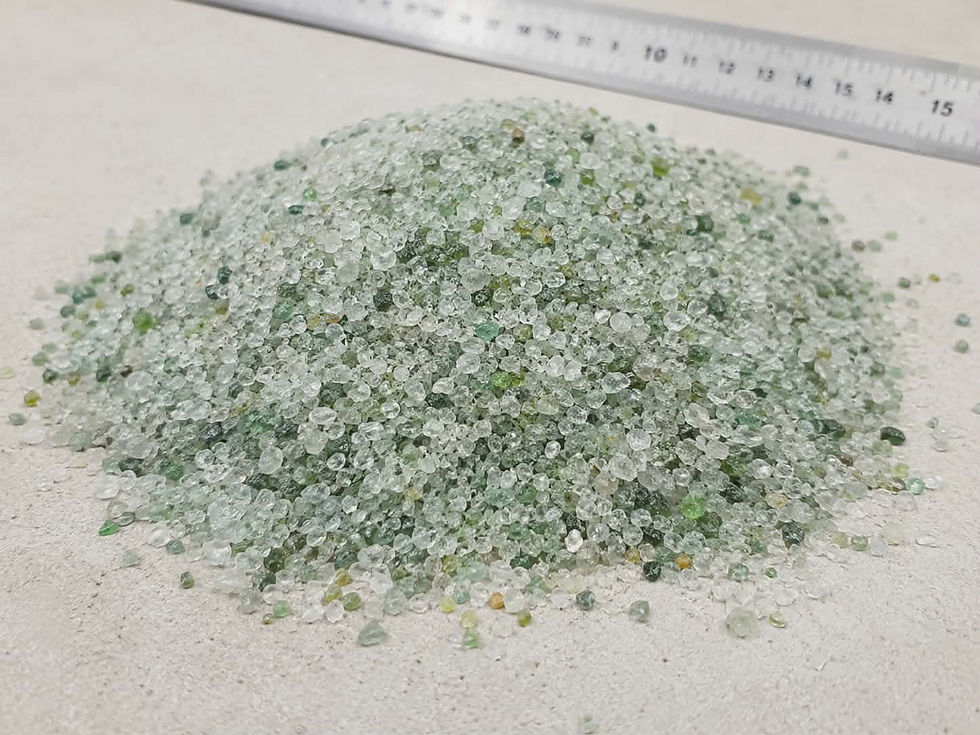
Glass Sand Replacement
Processed glass can be used as a partial replacement for natural fine aggregates.
This approach seeks to reduce reliance on natural sand resources while utilising a recycled material stream.
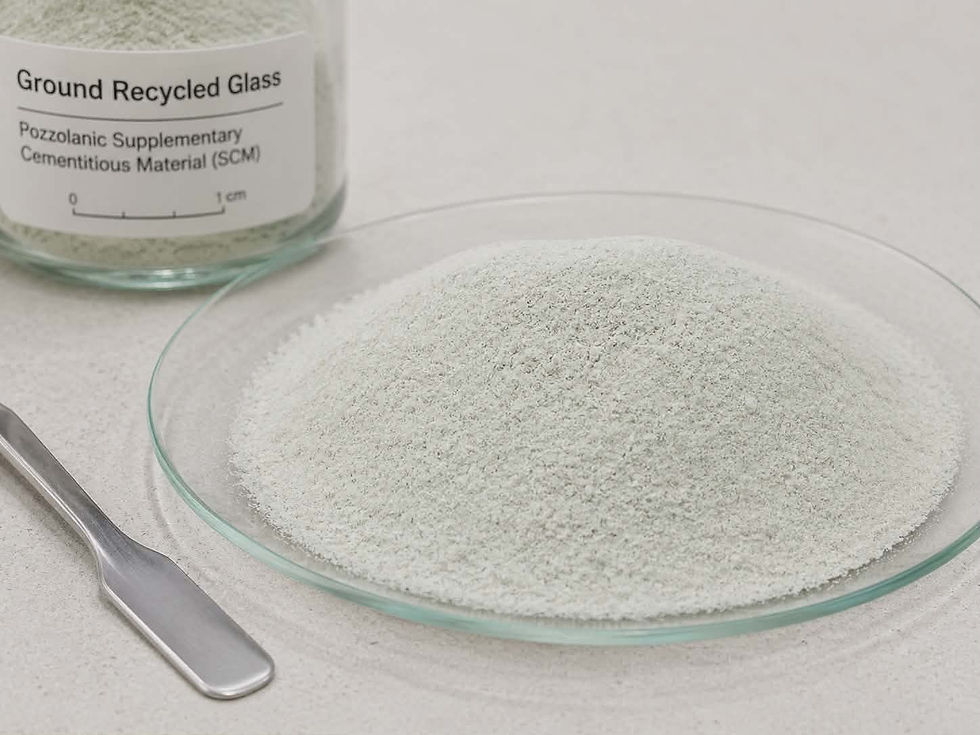
Glass Powder as a Supplementary Cementitious Material
When ground sufficiently fine, recycled glass can exhibit pozzolanic behaviour, reacting with calcium hydroxide within the cement matrix to contribute to strength and durability development.
This application often presents greater technical opportunities than direct aggregate replacement.
The Technical Challenge
While recycled glass offers clear sustainability benefits, successful implementation requires careful engineering.
The primary concern historically associated with glass in concrete is Alkali-Silica Reaction (ASR).
ASR occurs when reactive silica within aggregates reacts with alkalis in cement paste, causing expansion and cracking over time.
Because glass is largely composed of silica, early concerns focused on its potential to increase ASR risk.
However, research has demonstrated that particle size plays a critical role.
When recycled glass is ground sufficiently fine, it can actually help mitigate ASR while contributing pozzolanic activity within the concrete matrix.
This highlights an important lesson in materials engineering:
Performance is often determined not simply by material type, but by how that material is processed and utilised.
Practical Considerations
Successful use of recycled glass requires consideration of:
• Particle size distribution
• Glass source consistency
• Contaminant control
• ASR mitigation strategies
• Strength development characteristics
• Workability impacts
• Durability requirements
Like any alternative material, recycled glass must be assessed within the context of the intended application rather than viewed as a universal solution.
The Role of Mix Design
The incorporation of recycled glass should never be treated as a simple material substitution exercise.
Mix performance remains dependent on the interaction between:
• Cementitious materials
• Aggregates
• Admixtures
• Water demand
• Construction requirements
A properly engineered mix design is essential to ensure sustainability objectives do not compromise performance, durability, or constructability.

Looking Ahead
As pressure increases to improve sustainability outcomes across construction and infrastructure projects, recycled materials will continue to play a growing role within concrete technology.
Recycled glass represents one of several opportunities available to the industry.
However, the most successful applications will be those where sustainability objectives are balanced with sound engineering principles and practical production realities.
The future of concrete is unlikely to be driven by a single material innovation.
Rather, it will be shaped by the intelligent integration of alternative materials, improved production practices, and practical engineering solutions that deliver both environmental and commercial value.
At Concrete & Geotechnical Engineering, we believe the real opportunity lies not simply in using recycled materials, but in understanding how to make them perform reliably in the real world.


Comments